
Goblet in. Accurate count out. In under a minute.
A four-step workflow that any technician can run — no special training, no cleaning, no risk to dose quality. Behind the scenes, a sophisticated computer-vision pipeline handles every challenge that makes manual counting so difficult.
Four steps. Under sixty seconds.
Place the goblet
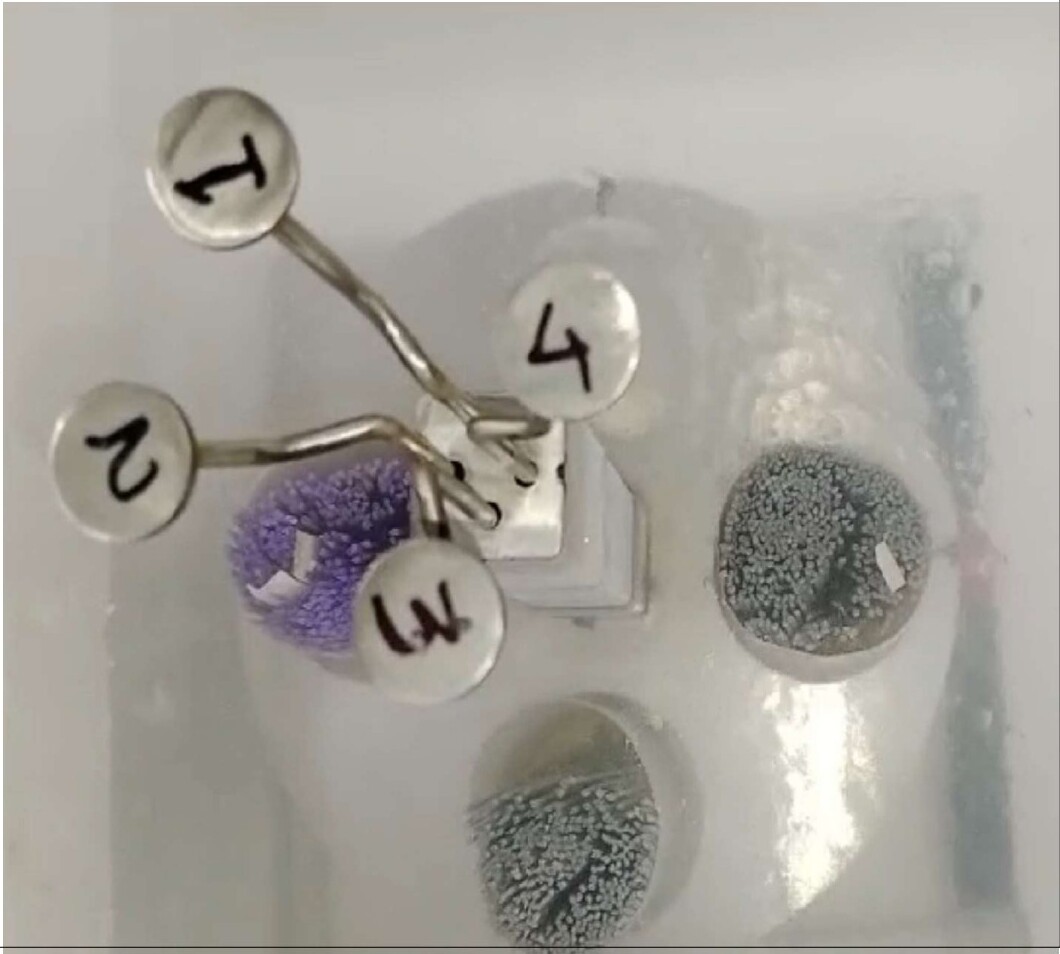
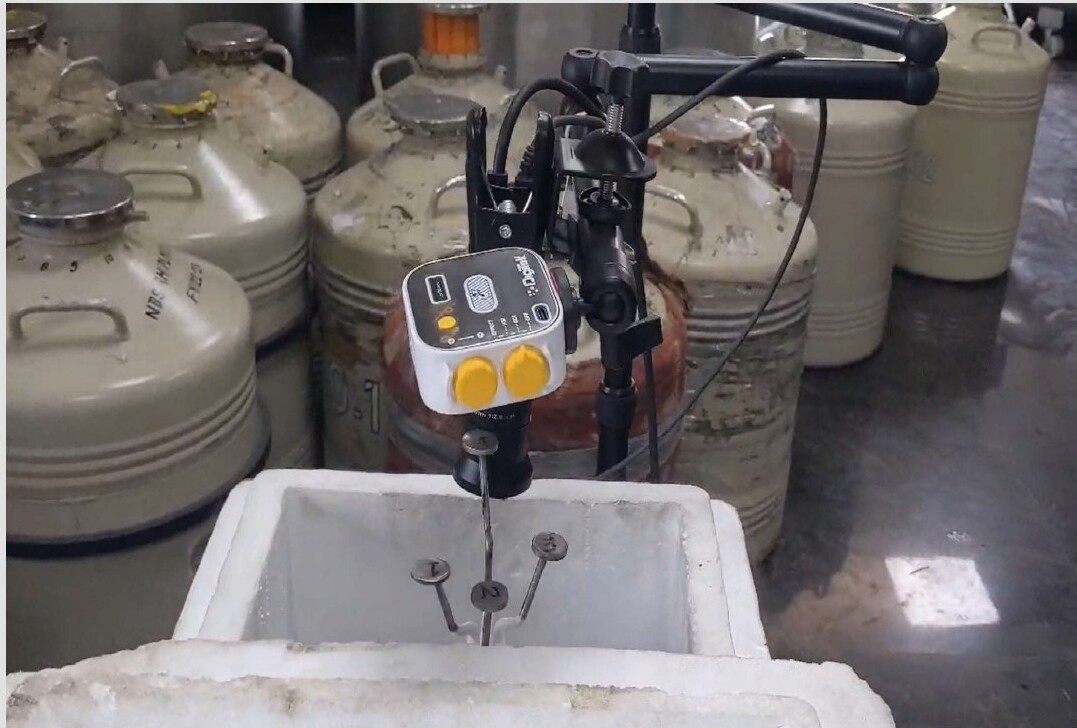
Lower the goblet into the liquid-nitrogen container under the SemenStrawCOUNTER. The goblet remains immersed throughout the entire process — straws never leave the cryogenic environment.
Capture
The 20MP industrial camera captures the goblet from above while the precision rotation stage spins it for a full 360° view. Multiple frames are captured to handle reflections, condensation, and overlapping straws.
AI detection
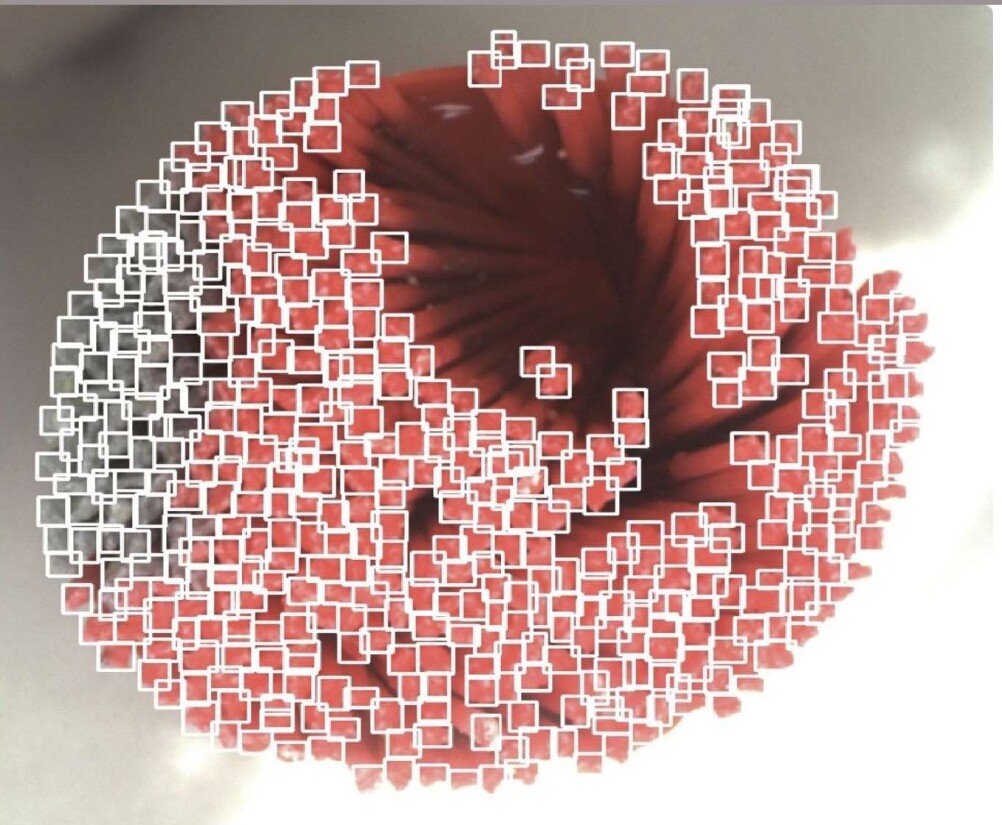
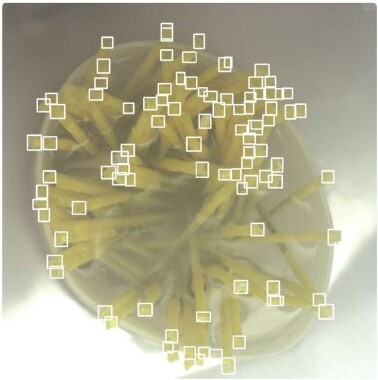
The deep-learning model processes the captured imagery, detecting every individual straw with bounding boxes, confidence scores, and color classification — typically in under 5 seconds.
Count & report
The system displays the count for operator confirmation, generates a full report and packing list, and pushes the data to your ERP via REST API or webhook.
Watch SemenStrawCOUNTER work
A short walkthrough of the full scan-to-report workflow — from placing the goblet in liquid nitrogen to receiving an accurate, audit-ready count in seconds.
Doses stay frozen. Always.
The goblet is never lifted out of the liquid nitrogen during the count. The camera images down through the vapor and our model is trained to handle reflections, condensation, and varying lighting — so semen quality is preserved end-to-end.
- Goblet remains submerged for the entire scan
- No thermal cycling — straws never warm up
- No physical contact with the doses
- Validated for continuous-duty cryogenic operation
What happens in those 60 seconds.
From the moment the scan button is pressed to the final count appearing in your ERP — six tightly choreographed stages, all running locally on the bundled hardware.
Image acquisition
Multi-frame capture from the global-shutter camera with controlled lighting, optimized for the unique challenges of cryogenic environments — vapor, condensation, and reflective surfaces.
Pre-processing
Frames are denoised, color-corrected, and aligned. Reflections from the liquid nitrogen surface are filtered, and the goblet boundary is automatically detected and cropped.
Detection inference
A purpose-built deep-learning model identifies each straw, draws a bounding box, classifies its color, and assigns a confidence score. Inference runs locally on the bundled GPU-accelerated laptop.
Aggregation & dedup
Detections from multiple frames are merged using spatial deduplication to eliminate double-counting where straws appear in overlapping captures.
Validation
Operators see the annotated image with every straw highlighted. Low-confidence detections are flagged for quick review. The operator can confirm or adjust before saving.
Sync & report
The final count, image, metadata, and audit trail are stored locally and pushed to your ERP via REST API. A PDF packing list is generated automatically.
An AI that learns your workflow.
The detection model is purpose-built for frozen straws — not a generic object detector retrofitted to the task. It's trained on millions of annotated goblet images spanning every common straw color, packing density, and lighting condition our customers operate in.
Each scan refines the model's understanding of your specific straw types, goblet sizes, and conditions. Accuracy improves with every count, and periodic retraining is delivered seamlessly to your installation.
Designed for the hardest conditions.
Counting straws in liquid nitrogen is not a textbook computer-vision problem. We engineered for every real-world challenge from day one.
Cryogenic vapor
Liquid nitrogen creates constant vapor that obscures or distorts standard imaging. Our optical setup and pre-processing pipeline are designed specifically to see through it.
Reflective surfaces
The liquid nitrogen surface and metallic goblet edges create reflections that confuse generic vision models. Ours is trained explicitly on these conditions.
Variable lighting
Lab lighting is rarely controlled. The system uses its own integrated illumination and exposure compensation to deliver consistent imagery regardless of ambient conditions.
Dense packing
Goblets often hold straws packed shoulder-to-shoulder. The model is trained on the worst-case packing densities our customers see in production.
What the model sees.
Common questions, answered.
What if a straw is partially hidden behind another?
The rotation stage captures multiple angles, and the model is trained on heavily occluded straws. In dense goblets, low-confidence detections are surfaced for the operator to confirm.
How does the system handle different straw colors in the same goblet?
The model classifies each detected straw by color and provides a per-color breakdown in the final report — useful for tracking mixed-batch goblets.
What happens to scan data?
Everything stays on the local hardware by default. You control whether and when data leaves your network. Optional cloud sync is available for multi-site operations.
Can the operator override the count?
Yes. The operator UI shows the annotated image with every detection. Operators can confirm, flag, or adjust the count, and every action is logged in the audit trail.
See it run on your goblets.
We'll bring a real goblet from your operation through the full pipeline, live.
Book a live demo